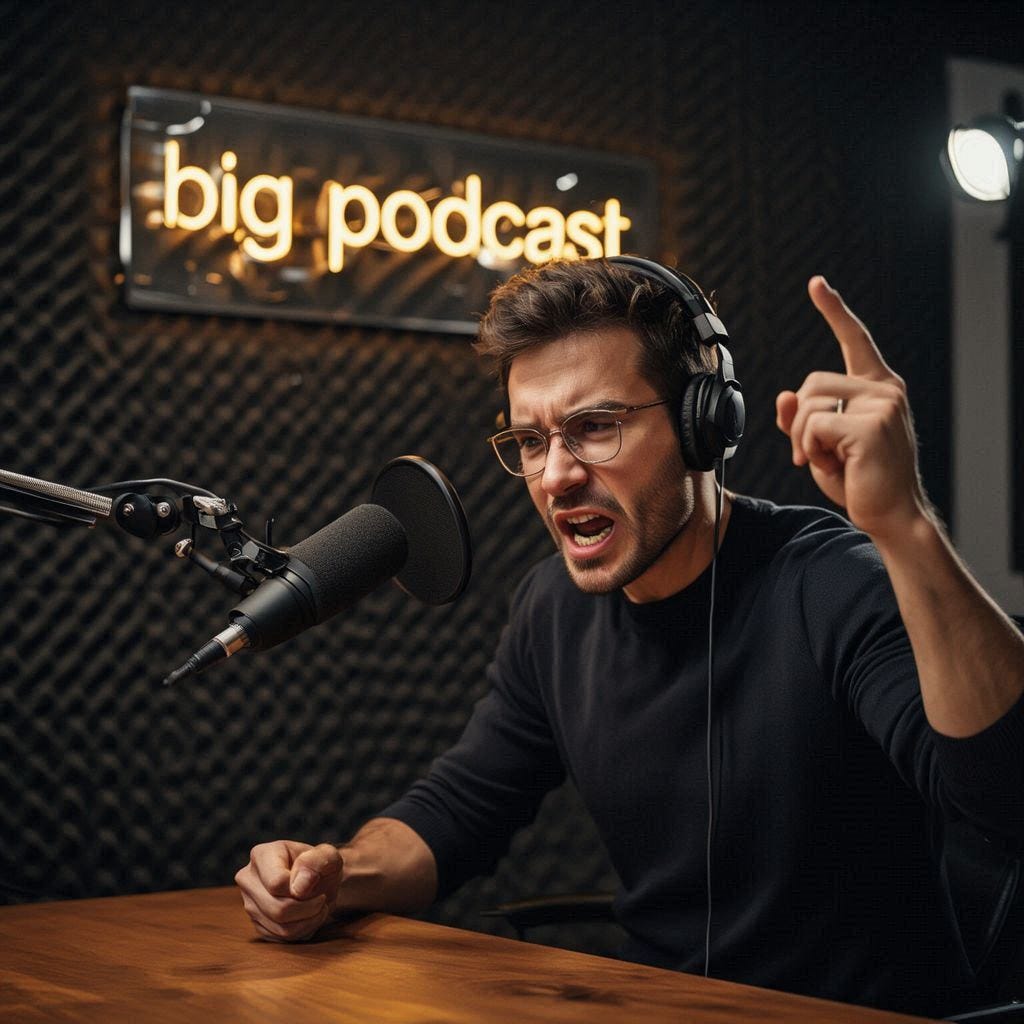
Your Guest is Hostile ... Now What?

I've done hundreds of long-form interviews over the years, and one of the most common questions I get is, “Who was the worst guest you’ve ever interviewed?”
“Worst” is relative. I had one situation where the guest stood up during the middle of the interview, declaring, “This interview is over,” and walked out …
But we ended up with one of our best episodes.
And I’ve had more than a few “really nice people” who didn’t give me enough for a full episode …
The Nutty Professor
Jerry Lewis (1926–2017) was a comedian, actor, director, and producer best known for his slapstick comedy, high-energy performances, and long-running partnership with Dean Martin. He starred in and directed a string of popular films from the 1950s and 1960s, including The Nutty Professor.
He was especially influential behind the camera for his innovative use of video playback on set and widely recognized for hosting the Muscular Dystrophy Association Labor Day telethons for decades, raising billions for research and care.
He was also known as a very tough person to interview.
Marc Maron talks about his experience interviewing Jerry Lewis here. I talked about hostile guests on Big Podcast Playbook and have a notorious clip of Jerry Lewis here.
Reviewing this footage sent me down a rabbit hole …
Was Jerry Lewis always like this?
Short answer: No. It depended on the interviewer and the phase of his career.
✅ Jerry Lewis could be hostile
Jerry Lewis had a reputation for being combative, defensive, and impatient in certain interviews, especially:
When he felt disrespected or misunderstood
When interviewers treated him only as a clown and ignored his work as a director, writer, or innovator
When questions repeated old critiques he’d already heard for decades
In those cases, he was known to:
Cut interviewers off
Correct them sharply
Mock the question
Shut the interview down emotionally
✅ He was defensive about his legacy
Lewis believed:
He was ahead of his time in film comedy
He was not given proper credit in the US (compared to Europe)
Critics underestimated his technical innovations (video assist, directing style, editing control)
So when interviews touched on:
“Why didn’t your movies age well?”
“Why were you more popular in France?”
“Were you just a kid’s comedian?”
… his tone often shifted fast.
❌ He was not always hostile
With interviewers who:
Did their homework
Treated him seriously as a filmmaker
Asked about craft, not gossip
… he could be:
Generous
Funny
Insightful
Proud without being abrasive
Long-form conversations (film schools, respectful retrospectives) usually went smoothly.
Context Matters in Interviews
Age and Health Matter
Where someone is in their life shows up in an interview. A younger guest may have more energy and fewer filters, while an older guest may bring perspective, caution, or a desire to reflect rather than perform.
Health plays a role. Someone managing illness, recovery, or burnout may be more reserved, distracted, or emotionally raw.
Situations Matter
What’s happening around a guest often matters as much as what they’re saying. Someone in the middle of a tour, a press run, or a heavy travel schedule may be exhausted, overstimulated, or dealing with issues that have nothing to do with you as a host. If a guest is jet-lagged, short on sleep, or mentally elsewhere, you’re likely going to work a bit harder to get something good.
Hosts often forget that we are interviewing other humans, many of whom are juggling competing demands. Keeping this in mind and working with it can change the trajectory of your interviews.
Career Trajectory Matters
Where a guest is in their career influences how they show up. Someone on the way up may be hungry, open, and eager to tell their story. A guest at a career peak might be more guarded, polished, or cautious with their words. Someone on the back end of a career may be reflective, candid, or less concerned with optics.
Understanding a career trajectory can help you read the room and adjust your approach so the conversation feels natural instead of forced.
Bottom Line
Jerry Lewis wasn’t hostile by default, but he was quick to go on offense.
In today’s terms, we might call him “protective of his brand” and deeply sensitive to framing.
He wasn’t difficult for sport. He was difficult when he felt minimized, misframed, or talked down to. The clips we see online are a highlight reel, which may have helped to frame him in a way that isn’t entirely accurate.
With that said, Jerry Lewis was known to be “difficult” to work with. He wasn’t exactly a “go with the flow” type of guy, as this live clip from his telethon showcases:
The lesson for hosts is simple: prepare for an interview, but there are a lot of things you are not in control of.
Preparation and respect don’t just make for better interviews—sometimes they’re the difference between a train wreck and a classic episode. But sometimes there’s nothing you can do to talk away with something great.
Show up in the best possible way and trust that you’ll be able to handle whatever is thrown at you. But also know when it’s time to walk away and turn your focus to what’s next.